By Ans Ali
Web Design & Development
Framer vs Next.js: What Should Your Startup Actually Use?
summary
Framer or Next.js? Compare SEO, design freedom, performance, CMS and development needs to choose the right website platform for your startup.
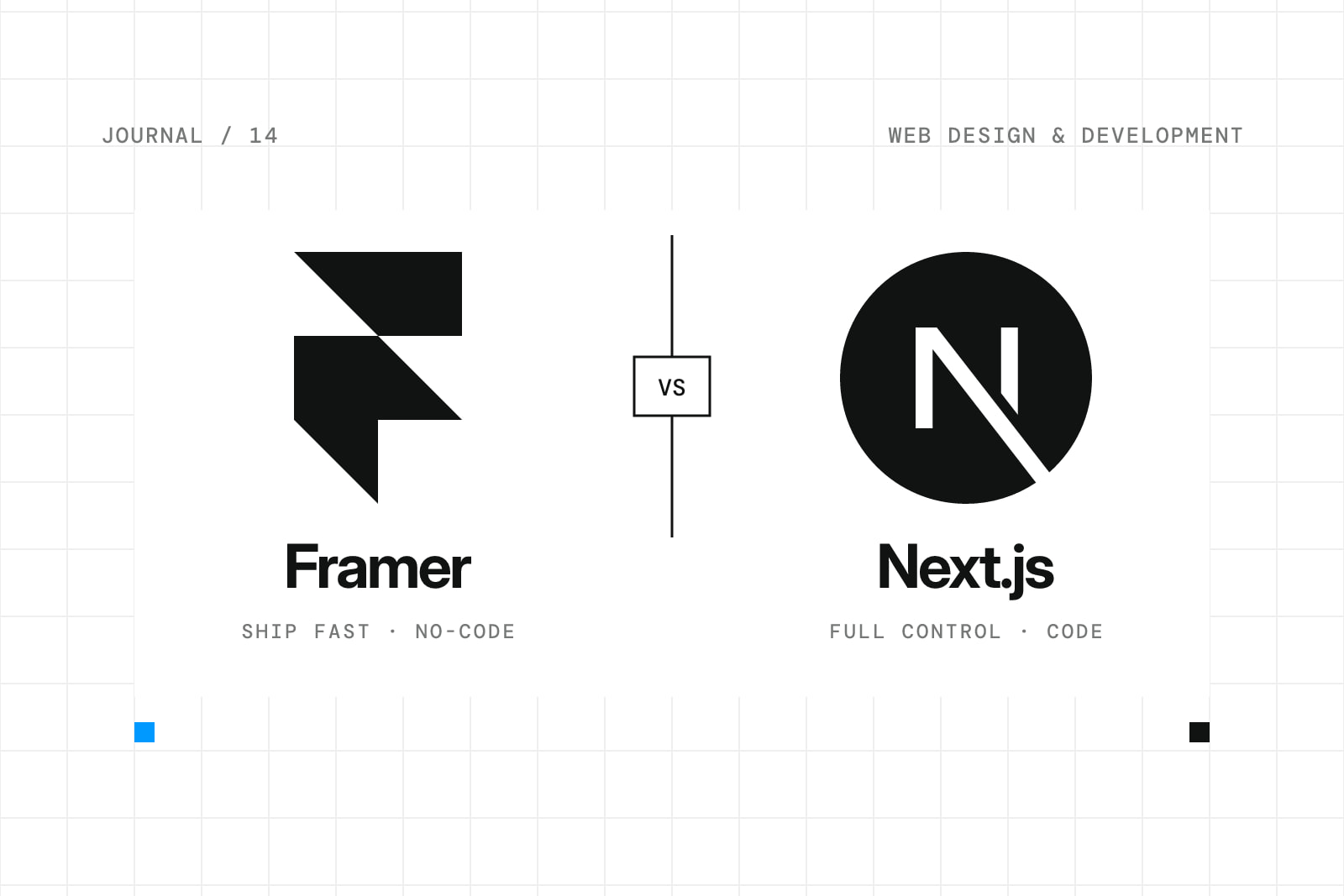
Framer or Next.js? It's a question worth asking before building a startup website, because the choice affects more than the technology behind it.
The short answer: Framer is often a strong fit for design-led marketing websites that need fast visual iteration and straightforward content management. Next.js makes more sense when the website requires custom application logic, advanced integrations, or deeper engineering control. Neither is automatically better for SEO or conversions.
I've worked across both design and development, and I think founders sometimes spend too much time debating the platform before defining what the website actually needs to do.
Let's make that decision simpler.
When Framer Makes Sense
Framer is particularly useful when the website itself is the main deliverable.
Think startup homepages, product marketing websites, portfolios, and campaign pages.
You can create expressive layouts, manage content through a CMS, and make visual changes without rebuilding an entire front-end application.
For an early-stage startup still refining its positioning, that flexibility can be valuable.
Why I'd Consider Framer
A startup marketing website usually needs a few things:
Clear product positioning
Strong visual identity
Responsive layouts
Fast content updates
Search-friendly pages
A simple path to conversion
Framer can handle these requirements without demanding a large engineering workflow.
That doesn't mean every Framer website is automatically fast or well-designed. The result still depends on how it's built.
When Next.js Is the Better Choice
Next.js becomes more interesting when a website needs to behave like a product.
Imagine building an interactive pricing calculator, a customer portal, a complex content platform, or an application connected to several backend services.
At that point, engineering flexibility may matter more than visual editing convenience.
Next.js gives developers more control over rendering, application architecture, integrations, and custom behavior.
Where That Flexibility Helps
You might choose Next.js when you need:
Custom authentication or user accounts
Application-like functionality
Complex API integrations
Highly customized interactive experiences
More control over deployment and application architecture
Shared components between a website and product
Of course, more control also means more responsibility.
Someone needs to maintain the code, manage dependencies, and make sure the application continues working.
What About SEO?
Both Framer and Next.js can support search-friendly websites.
Framer provides page metadata, CMS-driven content, semantic markup, sitemaps, and indexing controls.
Next.js provides metadata APIs, rendering options, and flexible ways to generate content and routes.
But choosing a platform isn't an SEO strategy.
Your content still needs to answer real questions. Your pages need clear structure, meaningful internal links, and good performance.
A beautifully engineered Next.js website with confusing content can perform worse than a well-structured Framer website.
The reverse is also possible.
My Approach to Choosing
I usually start with three questions.
What are we building? A marketing website and a SaaS product have different requirements.
Who will maintain it? A founder who wants to update copy independently may need a different workflow from a team with full-time developers.
What will it need six months from now? Consider likely integrations, new pages, product features, and how often the design will change.
If the website mainly explains the product and generates leads, I would seriously consider Framer.
If it needs custom functionality or deep technical integration, I'd lean toward Next.js.
And sometimes the best approach is to use Framer for marketing and a separate application stack for the product.
Frequently Asked Questions
Is Framer good for startup SEO?
Yes. Framer supports essential SEO functionality, including page metadata, CMS content, and sitemaps. Results depend on content quality, site structure, performance, and other factors.
Is Next.js faster than Framer?
Not automatically. Either platform can deliver a fast website or a slow one. Implementation quality, assets, third-party scripts, and hosting choices all matter.
Can I move from Framer to Next.js later?
Yes, but it generally requires rebuilding or migrating the implementation. Plan for content, redirects, assets, and integrations rather than assuming a one-click conversion.
Which should an early-stage SaaS startup choose?
For a relatively straightforward marketing website, Framer is often practical. For a complex custom application or deeply integrated site, Next.js may be a better foundation.
Building a startup website?
I help founders choose the right direction, design the experience, and build what the product actually needs.
Book a call
Let's make something happen.
Building a product, launching a startup, or rethinking your website? Pick a time that works for you and let's talk through your project, goals, and next steps.